

Barber Institute
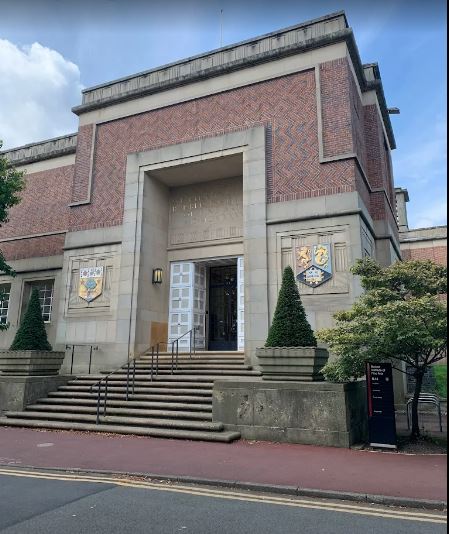
The Barber Institute of Fine Arts is a Grade I listed Art Deco museum and concert hall located on the University of Birmingham campus. Founded in 1932 by Lady Martha Constance Hattie Barber, it was established as a memorial to her husband, Sir William Henry Barber, 1st Baronet (1860-1927), a successful Birmingham property developer, art collector and solicitor. He died, leaving a fortune of the 2026 equivalent of more than £22million to his wife. Lady Barber signed the Deed of Settlement on 13 December 1932, creating the Henry Barber Trust. Having no children, Lady Barber left her entire fortune to the University of Birmingham, specifically to build a facility for the study and encouragement of art and music. The trust deed stipulated that all acquisitions must be 'of that standard of quality as required by the National Gallery and the Wallace Collection'.
The building was designed by Robert Atkinson, a leading architect known for his Art Deco cinema designs. The building was officially opened by Queen Mary on 26 July 1939, just weeks before the outbreak of World War II. The structure, unique for its time, was designed as an integrated facility with a central auditorium surrounded by galleries, a library, and lecture halls. The building was extended in the 1960's by the addition of a music library. and again in the 1980's with a metal and glass roof.
Its first Director, Professor Thomas Patrick Bodkin KCSG (1887-1961), acquired the nucleus of the collection, which was stored at the National Gallery in London until the Birmingham building was completed. It houses one of the finest small art collections in Europe, including works by Monet, Manet, Gainsborough, Turner, and Botticelli. 20th Century 'Master' includes works by Frank Auerbach, Pierre Bonnard, Gwen John, Fernand Léger, Walter Sickert and Picasso, to name but a few. It also contains one of the world's largest and most significant coin collections, with roughly 15,000 items added in 1967 alone.
The building was upgraded to Grade I listed status by Historic England in September 2020 for its exceptional architectural and historic interest and is currently undergoing a phased transformation. It temporarily closed in October 2023, reopened in June 2024, and closed again on 26 January 2025 for further refurbishments
Image(s) below (click to enlarge):
Number of Artists referenced:
19